




The Picture of Dorian Gray: Oscar Wilde for the Digital Age
A bold reimagining of Oscar Wilde’s The Picture of Dorian Gray is now captivating audiences at the Music Box Theatre.

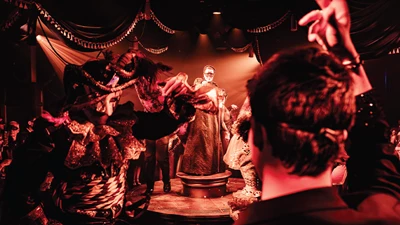
Masquerade, the new immersive New York City event based on the musical, The Phantom of the Opera, transforms the iconic, long-running musical into an interactive experience. Building on the success of Sleep No More and other genre pioneers, the production surrounds guests in a whirlwind of stunning sets and intimate performances. At the same time, its lavish creative vision poses technical-production challenges that span all disciplines.
Tony Award–winning director Diane Paulus (Pippin) leads this production along with production designer James Fluhr and designers Scott Pask (scenic), Ben Stanton (lighting) and Brett Jarvis (sound). PRG is proud to have provided technical services including scenic, automation, lighting and audio for this unique experience.
“This team is very experienced with experiential, walk-through events,” said Mark Peterson, General Manager, Sales & Business Development at PRG. “Their expertise is reflected in the meticulous design, which invites participants to not only watch but experience the story up close.”
The main challenge is the venue itself: Set in the historic Lee's Art Supply building on 57th Street in New York City and encompassing 5 floors of the retail space, Masquerade’s guests move through the show’s scenes from the underground Lake and Grotto to the Opera House. The site presents limitations such as low ceilings which limit the size and scale of the scenic pieces and no overhead rigging points, necessitating temporary structures for lighting and audio gear. Additionally, groups are admitted at 15-minute intervals, meaning that there is almost no reset time for each scene.

“We had to approach this as if every floor was its own unique production,” said Thomas Smith, Account Executive, Theatre Lighting, PRG. “We had to sort out the power for the venue, locating and distributing power via multiple power centers – one can supply a part of one floor, while another can supply multiple floors. Equipment rooms were built on each floor so the crew must visit each location for operation and maintenance."
Andres Alzaté, PRG Account Executive for Audio, added, “On Broadway, you have a fixed stage, a defined audience position and a predictable acoustic footprint. This allows us to design a sound system once and tune it to the room, so every performance essentially takes place under the same conditions.” However, with Masquerade, each environment has its own acoustic properties from reflective floors to intimate, enclosed chambers. The sound design must adapt seamlessly to make the storytelling feel continuous necessitating distributed, networked audio systems across the venue."

The mobility of performers introduces additional challenges. “The actors and musicians move through the same spaces as the guests, so that requires careful microphone placement and robust wireless coverage,” Alzate pointed out. “We had to engineer dozens of localized systems—ceiling speakers, wall mounts, compact arrays—ensuring that every guest receives a consistent experience, regardless of their path through the show. While the music is mostly pre-recorded, all vocal performances are live, which adds another layer of complexity.”

“We can't fly traditional line arrays because the ceilings are so low; instead, we deployed compact distributed systems that can fit into the architectural features of the venue. A Broadway musical might rely on a dozen wireless channels with a flown PA system. For Masquerade, the magnitude is much larger - over 100 compact speakers scattered throughout the various rooms and 42 channels of transceivers for wireless microphones and in-ear monitors.”
Scenic challenges also demanded innovative solutions. For the scene that takes place in the underground lake, a boat’s travel is tracked using a magnetic strip system. Peterson explains, “You can literally adhere the magnetic tape to the floor, and the tracking system’s laser eye follows that strip. The advantage of this over a traditional deck track is significant, if adjustments are needed in the boat's movement, you can simply peel up the tape and reattach it. The fundamental idea is that we can create our own tracking path without needing to install a deck and track.”

Peterson continued, “The boat can be programmed for acceleration and deceleration, as well as incorporating cuts in the magnetic strip for cross-signals using magnets. For instance, placing a magnet on one side of the tape can trigger it to slow down or pause.”
And for the legendary opera-house chandelier, Troy Atkinson, Managing Director, PRG, explains, “Given that the building is over a hundred-year-old and the ceiling is only 16’ high, we needed to bring in our own freestanding truss structures, which allowed us to test the entire setup in our shop ahead of time. The chandelier, which weighs 800 lbs. and is made up of four rings, is fixed in place throughout the performance. We automate each individual ring, which range in diameter from 1.5 to 13 feet, so as the top ring approaches the ceiling, the others continue to rise. This creates the illusion that the chandelier is larger than the room itself.”

Atkinson continued, “The next time the audience enters this room, we have the iconic chandelier crashing scene. The first two rings at the bottom drop suddenly with a speed of about six feet per second, transitioning into a slow-motion collapse scene. Winches on the rings make them capable of tilting too.” Troy continued, “Inside the larger ring are smoke and lighting effects, designed to create the appearance that the chandelier is on fire. Steam is released, and LED pixel tape creates a flickering effect to simulate flames. It was an effective way to re-create the iconic moment from the theatrical production.”
Masquerade is currently playing at 218 W 57th St in New York, NY.
A bold reimagining of Oscar Wilde’s The Picture of Dorian Gray is now captivating audiences at the Music Box Theatre.

Swept Away: A New Musical Tale officially opened on Broadway and we're thrilled to have played a part in bringing this captivating production to ...

PRG is proud to once again support Buena Vista Social Club as it made its Broadway debut.